


Basalt Fiber Sleeve Market Segment Analysis, Share, and Forecast Report (2025-2035)
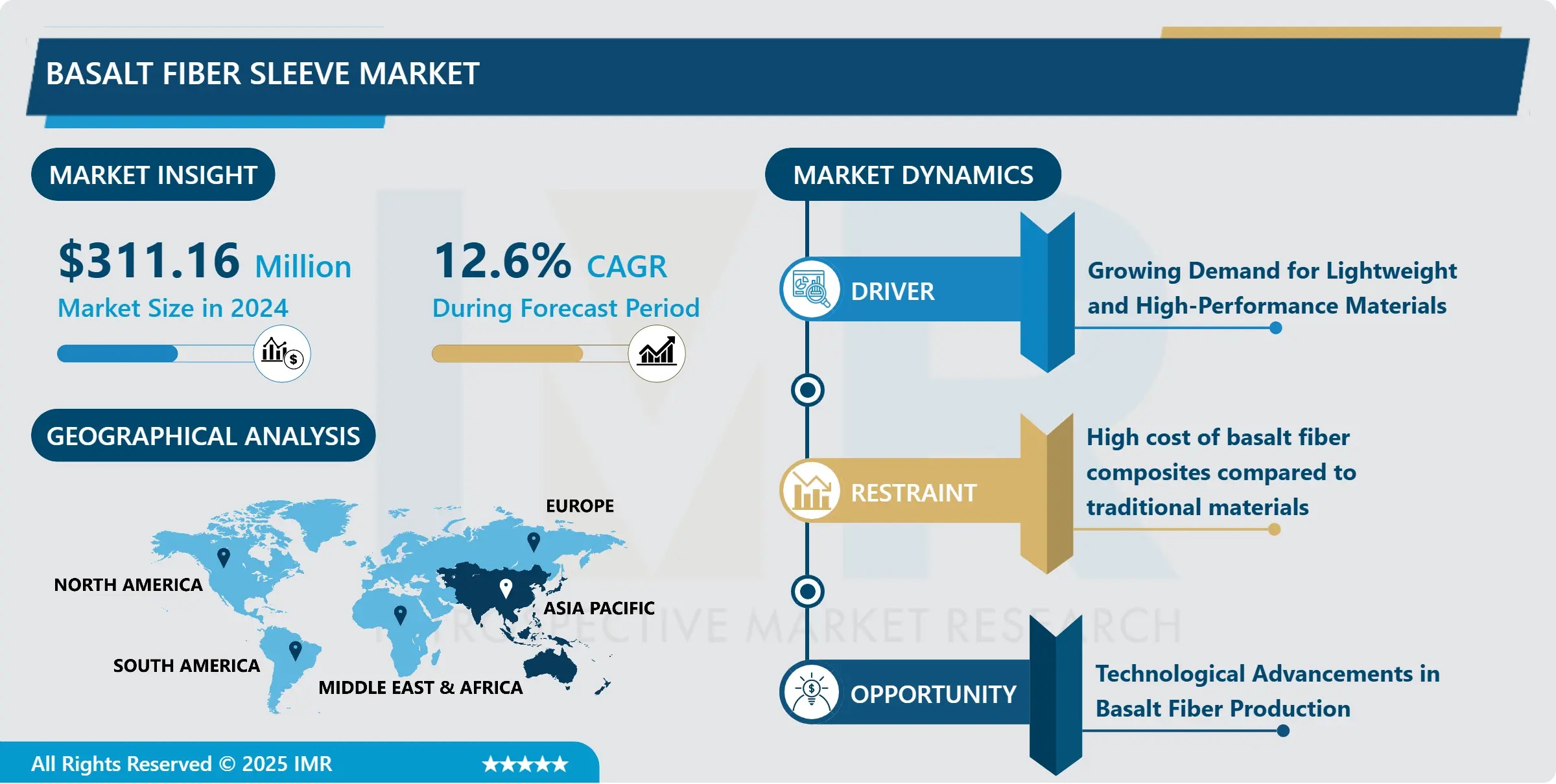
The global Basalt Fiber Sleeve Market according to the report published by Introspective Market Research, the Basalt fiber Sleeve market-valued at approximately USD 311.16 million in 2024-is projected to expand to USD 1,147.91 million by 2035, representing a compound annual growth rate (CAGR) of 12.6% during 2025–2035.
This growth is being propelled by rising global demand for lightweight, high-strength, heat-resistant and environmentally friendly materials across automotive, construction, aerospace, energy, and industrial sectors. The push towards sustainable materials, regulatory pressure to reduce carbon footprints, and the need for durable insulation and protective solutions in harsh environments are driving a shift from traditional glass and carbon fibers to basalt fiber sleeves.
Quick Insights
· 2024 Market Size: USD 311.16 million
· 2035 Forecast Market Size: USD 1,147.91 million
· Forecast CAGR (2025–2035): ~ 12.6%
· Primary Material Advantage: Basalt fiber-derived from volcanic rock; offers superior thermal stability, chemical resistance, corrosion resistance, high strength-to-weight ratio, and eco-friendly profile.
· Top Application Segments: Electrical insulation, thermal insulation, protective sleeves for automotive/industrial piping, composite reinforcement in construction & infrastructure, aerospace components.
· Leading Region (2024): Asia-Pacific-driven by rapid industrialization, infrastructure development, and expanding automotive & manufacturing sectors.
· Notable Industry Drivers: Growing demand for sustainable materials; stricter fire-safety and environmental regulations; rising need for high-temperature and corrosion-resistant materials across sectors.
Market Snapshot: Revenue Forecast (2024 vs 2035)
|
Year |
Global Basalt Fiber Sleeve Market Size (USD Million) |
|
2024 |
311.16 |
|
2035 (Forecast) |
1,147.91 |
What’s Fueling the Growth?
IMR’s research identifies several core drivers behind the surge in demand for basalt fiber sleeves:
· Sustainability & Eco-Friendly Materials Push: Basalt fiber is produced from natural volcanic rock-a greener alternative to glass or carbon fiber-offering comparable or better strength and thermal properties with a lower environmental footprint.
· Need for High-Performance Thermal / Electrical Insulation: In the face of stricter safety, fire-resistance and insulation standards (in electrical, industrial, marine, and energy sectors), basalt fiber sleeves provide heat resistance, corrosion resistance, dielectric insulation and long-term durability-making them highly suitable.
· Demand from Automotive, Aerospace & Industrial Applications: As industries push for lightweight, durable, and heat-resistant components-especially in EVs, aerospace, oil & gas-basalt fiber sleeves and composites are increasingly replacing traditional materials.
· Infrastructure & Construction Boom, Especially in Asia-Pacific: Rapid urbanization, construction growth, and expanding industrial base are driving demand for reinforcement, insulation, and protective materials-boosting basalt fiber sleeve uptake.
· Advances in Manufacturing & Cost-Effectiveness: Improvements in production technologies and rising economies of scale have made basalt fiber sleeves more cost-competitive versus higher-cost carbon fiber alternatives-enhancing adoption potential.
What Opportunities and Trends Are Emerging?
Could basalt fiber sleeves become the default standard for sustainable, high-performance insulation and composite applications globally?
With growing environmental awareness, regulation push for fire-resistant & low-emission materials, and performance demands from automotive, aerospace, and construction sectors — basalt fiber sleeves are increasingly positioned as a preferred alternative to glass and carbon fibers. Manufacturers focusing on heritage basalt-rich regions, efficient processing, and sustainable supply-chains could gain early mover advantages.
Is Asia-Pacific set to dominate global demand and reshape the supply-chain for high-performance composites?
Given the region’s strong growth in automotive production, infrastructure development, industrial expansion and rising regulations on materials, Asia-Pacific (notably China, India, Southeast Asia) is likely to become the epicenter for both consumption and production. This could shift global supply-chain dynamics and encourage localization of manufacturing.
Expert Commentary
“Basalt fiber sleeves represent a compelling convergence of performance, sustainability and cost-efficiency,” said Dr. Rajiv Singh, Principal Consultant, Introspective Market Research. “As industries worldwide strive to meet tougher safety, environmental and emissions standards, basalt sleeves offer a powerful material option. Companies that invest now in scaling manufacturing, ensuring quality, and aligning with sustainable sourcing will lead the next wave of high-performance materials adoption.”
Regional & Segmentation Analysis
· Asia-Pacific: Leading and fastest-growing region-driven by booming construction, automotive manufacturing, infrastructure investment, and increasing demand for high-temperature insulation and corrosion-resistant materials.
· North America & Europe: Continue to adopt basalt fiber sleeves for aerospace, electrical insulation, industrial, marine, and specialty applications-focusing on premium, high-performance, regulation-driven markets.
· By Application:
o Electrical & Thermal Insulation-largest share due to demand for heat/fire resistant sleeves in electrical equipment, cabling, industrial machinery.
o Automotive & Transportation-growing demand for lightweight, heat-resistant sleeves for wiring, exhaust systems, battery protection, especially in EVs.
o Construction & Industrial Infrastructure-use in protective coatings, fireproofing, reinforcing structures where durability and corrosion resistance are critical.
o Aerospace, Oil & Gas, Marine, Energy-niche but steadily growing due to basalt fiber’s high-temperature, chemical-resistance and mechanical strength.
· By Product Type: Continuous basalt fiber sleeves dominate due to consistency, uniform strength, easy processing; hybrid or woven variants also gaining traction for specialty applications.
Recent Breakthroughs & Key Industry Developments
· Several global producers have expanded capacity to meet growing demand for basalt fiber sleeves-especially in Asia-Pacific-reducing cost and ensuring steady supply for mass-market adoption.
· Advances in manufacturing and processing technologies have improved thermal insulation performance, chemical resistance, fire retardancy, and mechanical strength-making basalt sleeves viable substitutes for traditional glass or carbon fiber sleeves in demanding applications.
· Rising adoption of basalt-based composites in automotive (particularly EVs), infrastructure, energy (oil & gas, renewal energy) and industrial sectors signals a strategic shift toward sustainable high-performance materials.
Cost Pressures & How to Drive Cost-Efficiency — Benefits for Stakeholders
Despite strong growth prospects, the Basalt Fiber Sleeve Market faces certain cost and supply-chain challenges:
· Raw-material sourcing and processing costs: Basalt rock extraction, high-temperature melting and fiberization involve energy-intensive steps, which can influence final product pricing.
· Competition from cheaper traditional materials: Glass fiber sleeves and conventional insulators may still offer lower upfront cost, especially in cost-sensitive segments.
· Supply-chain and scale-up challenges: In regions without local basalt deposits or processing facilities, logistics and import costs may add to overall expenses.
· Certification and quality consistency for high-end applications: Meeting stringent standards (fire safety, mechanical strength, industrial certifications) requires rigorous quality control, which adds overhead.
Strategies for Efficiency & Value Maximization:
1. Vertical integration and local sourcing: Establishing fiber-production and sleeve-manufacturing close to basalt sources reduces logistic cost and ensures raw-material availability.
2. Economies of scale & capacity expansion: Scaling production to meet global demand lowers per-unit cost and makes basalt sleeves more competitive versus glass/carbon alternatives.
3. Process optimization & energy-efficient manufacturing: Using modern furnace design, optimized melting and fiberizing techniques to reduce energy consumption and waste.
4. Targeting high-value, high-performance applications: Focusing on sectors (automotive EV, aerospace, oil & gas, infrastructure) that value performance over price-enabling premium pricing and better margins.
5. Sustainability and lifecycle-cost messaging: Positioning basalt sleeves as eco-friendly, long-life, low-maintenance alternatives-which over the lifecycle may yield cost savings compared to frequent replacement of cheaper materials.
These approaches will allow producers, converters, and end-users to balance cost pressures while capturing long-term growth-making basalt fiber sleeves a strategic material for the future.
Why This Matters
Basalt fiber sleeves represent a compelling intersection of sustainability, performance, and versatility — offering industries a materials solution that meets rising environmental standards, delivers high thermal and chemical resistance, and supports lightweight, durable design across sectors. As global demand for advanced materials grows — driven by automotive electrification, infrastructure expansion, industrial modernization, and environmental regulation — basalt fiber sleeves stand out as a key growth segment.
For raw-material suppliers, manufacturers, converters, infrastructure firms, automotive OEMs, energy companies, and investors — this market offers a high-potential growth pathway. Companies that invest in quality, supply-chain resilience, local capacity, and product innovation are likely to lead over the next decade.
Download & Connect
To access our full Basalt Fiber Sleeve Market Report — including detailed regional forecasts, segment-level breakdowns, competitive landscape, supply-chain analysis, pricing trends, and growth opportunity mapping — please Download Sample
About Introspective Market Research
Introspective Market Research (IMR) is a global market-intelligence firm specializing in specialty materials, advanced composites, industrial chemicals, infrastructure materials, and sustainable solutions. Our senior analysts deliver rigorous data-backed forecasts, competitive landscape analyses, supply-chain insights, and actionable strategic guidance — helping stakeholders navigate emerging markets and capitalize on growth opportunities with confidence.
Contact:
Introspective Market Research
Phone: +91-91753-37569.
Email: mailto:info@introspectivemarketresearch.com

 English
 Arabic
 French
 Portuguese
 Deutsch
 Turkish
 Dutch
Dutch
 Italiano
 Russian
 Romaian
 Portuguese (Brazil)
 Greek
Greek